

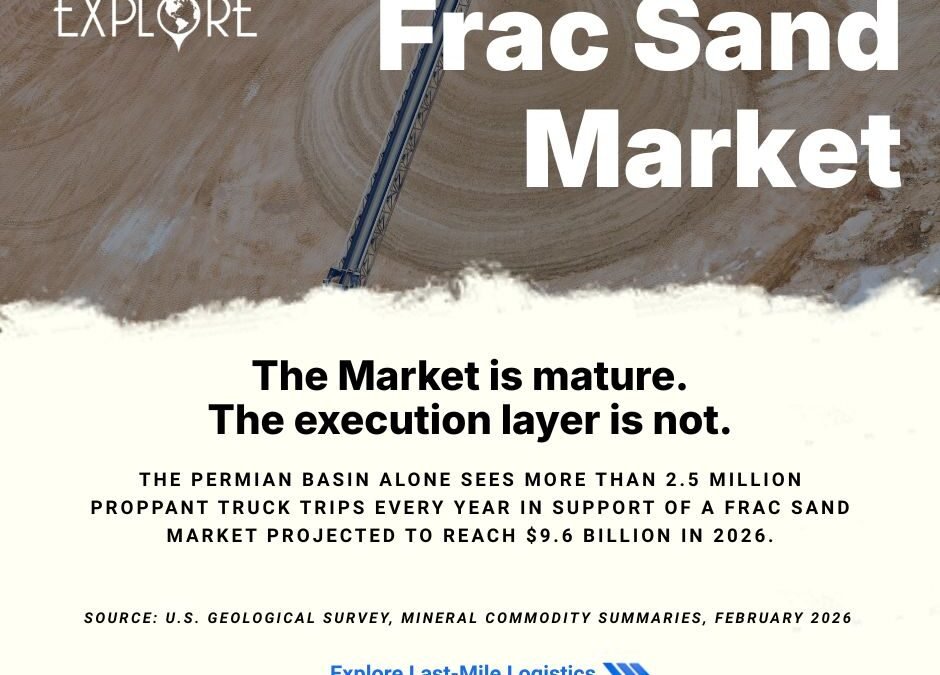
Frac Sand Hauling Companies in Texas: How Energy Operators Should Actually Evaluate the Field
TL;DR
Last mile logistic companies in Texas move proppant from mines and transload yards to active wellsites. The best ones are not measured by rate per ton. They are measured by dispatch coordination, basin fleet strategy, and stage timing reliability. Explore Group operates frac sand hauling across the Permian and Eagle Ford with one accountable operations contact.
Frac sand hauling companies in Texas operate inside one of the most demanding logistics environments in the country. A modern frac stage burns through 30 to 50 truckloads of sand per shift. When hauling slips, the stage slips.
This guide walks energy operators, procurement managers, and completions teams through the equipment categories that matter, the basins Texas haulers cover, the questions procurement should ask before signing, and the operational signals that separate the best frac sand hauling companies from the average ones.
What does a frac sand hauling company actually do?
A frac sand hauling company in Texas moves proppant from a sand mine or transload yard to the active wellsite. The work covers loading, transit, queueing, and unloading. When that work runs cleanly, frac stages stay on schedule, and proppant intensity targets get hit. When it does not, every downstream cost on the well multiplies.
Five-item evaluation checklist procurement teams can lift directly:
- Single named accountable operations contact with a direct line
- Documented dispatch logic for multi-asset coordination on the same pad
- Verified fleet strategy in the operator’s primary basin
- Mine relationships and demonstrated load-time variance handling
- Unload the coordination plan for box, pneumatic, or belly dump
What equipment do frac sand hauling companies in Texas use?
- Pneumatic trailers: Pneumatic trailers use air pressure to unload directly into onsite silos. The Advantage is simple and proven technology with very low mechanical failure. Works well with established silo infrastructure where pace matters more than container handling.
- Belly dump trailers: Belly dump trailers drop proppant by gravity through bottom gates into ground hoppers. Mass-move efficiency, simple equipment, and fast dumping. Fits sites where blender setups can receive ground-level proppant flow at scale.
- Box/container systems: Sealed containers are dropped at the pad and decoupled from the delivery truck. Delivery and unload run on independent schedules. Reduces queue exposure when frac crews and haulers are out of sync, which is the most common pad-level cost driver.
What basins do Texas frac sand haulers cover?
- Permian Basin (Midland and Delaware sub-basins)
- Eagle Ford
- Anadarko (border activity into Texas)
- Haynesville (East Texas activity)
Fleet strategy in the operator’s primary basin is the single biggest reliability indicator. A hauler that runs 80 percent of its fleet in the Permian can absorb a capacity spike that would crater a hauler running diversified routes.
How should procurement evaluate a frac sand hauling company?
Most evaluations stop at the rate per ton. The best procurement teams look at three additional dimensions:
- Dispatch transparency: visible scheduling, named operations contact, real-time updates
- Mine gate to pad coordination: how the hauler manages variable mine load times
- Cost stability under demand spikes: rate behavior when basin rig counts climb
What separates the best frac sand hauling companies from the average ones?
Average frac sand hauling companies in Texas can fill a load. The best ones can stay on stage, timing when the mine queues, the weather routes, and the frac crew unload pace all move at once. That difference does not show up in a rate sheet. It shows up in the completion log.
How does Explore Group approach frac sand hauling in Texas?
Explore Group runs frac sand hauling inside an integrated energy services model. Sand mine development, hauling, storage, and field coordination sit under one operations team. Multi-basin fleet strategy across the Permian and Eagle Ford. One accountable contact. The point is not just trucks. The point is staying on stage timing when the math gets tight.
Frequently Asked Questions
-
- How many truckloads does a frac stage require? Most modern Permian and Eagle Ford stages require 30 to 50 truckloads of proppant, depending on completion design.
- Are frac sand haulers responsible for sand quality? No. Sand quality is the mine’s responsibility. Haulers are responsible for the chain of custody and on-time delivery.
- What is the difference between mine-gate and delivered pricing? Mine-gate pricing puts hauling responsibility on the operator. Delivered pricing rolls hauling into the supply contract.
- How do hauling companies coordinate with frac crews? Through dispatch systems that match unload pace to delivery cadence, often with named operations contacts on both sides.
- Where does Explore Group operate frac sand hauling? Across the Permian Basin and Eagle Ford with a multi-basin fleet strategy.
If your last completion ran late because of sand delivery, the bottleneck is solvable.
Request a frac sand hauling RFQ