

TL;DR: Oil and gas supply chain management
Energy supply chain management for oil and gas is the coordination of materials, equipment, transportation, and field execution across the lifecycle of an oil and gas program, optimized for stage timing and completion reliability.
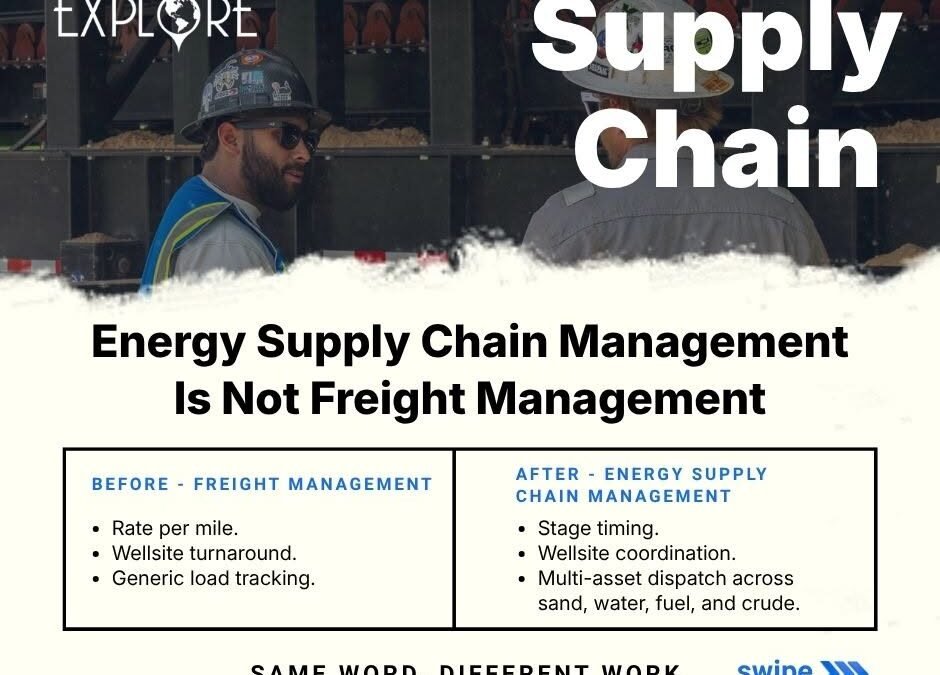
It differs from freight management because the KPIs, the risk profile, and the decision rights all change when the supply chain meets the wellsite.
In Business Development at Explore Logistics, I have one specific advantage: I get to see the same problem from both sides of the table.
I sit with energy operators who think they are buying freight, and I sit with logistics teams who think they are managing the supply chain the same way they would for any other industry.
Both groups are partly right. Both groups are also missing what makes energy supply chain management for oil and gas a different discipline.
This is the article version of that conversation.
Click here to contact us today!
What is energy supply chain management for oil and gas?
Energy supply chain management for oil and gas covers the planning, sourcing, transportation, storage, and field execution of all the materials and equipment a program needs to drill, complete, and produce wells. That is a long definition.
The simpler version is this: it is the coordination work that decides if a frac stage runs on time or not.
In a typical Permian frac job, that coordination touches sand suppliers, water haulers, fuel deliveries, crude logistics, equipment leasing, downhole tool providers, and dispatch teams. Any single one of those can stop a stage.
The job of energy supply chain management is to make sure none of them does.
How does it differ from freight or general logistics management?
- Different KPIs. Freight optimizes for rate per mile and hub turnaround. Energy supply chain management optimizes for stage timing, completion window adherence, and multi-asset dispatch accuracy. Click here to read a post on our LinkedIn profile
- Different risk profile. Freight risk shows up as late delivery. Energy supply chain risk shows up as a frac delay that cascades into millions of dollars of downstream cost.
- Different decision rights. Freight dispatch makes routing decisions. Energy supply chain coordination makes decisions that touch field operations, procurement, completions, and finance simultaneously.
- Different relationships. Freight relies on standardized lanes. Energy supply chain relies on basin-specific fleet posture, named operations contacts, and live coordination with frac crews.
What KPIs matter most in oil and gas supply chain management?
- Completion timing adherence: percentage of stages that run within the planned window
- Stage downtime: hours lost per stage to supply chain causes (sand, water, fuel, crude)
- Multi-asset dispatch accuracy: percentage of pad-level coordination calls that hit the right asset at the right time
- Recovery speed: time from a phase slip to operational recovery
What are the biggest risks operators face in their supply chain today?
Three risks come up in almost every conversation our team has with operators in 2026:
- Disposal capacity contraction. Permian SWD capacity has tightened in select sub-basins, which has reshaped water logistics economics.
- Driver and crew availability. Peak rig-count windows continue to stress driver supply, which compounds at the wellsite.
- Fragmented vendor stacks. Operators running four separate vendors for sand, water, fuel, and crude consistently see more handoff failures than operators running integrated coordination.
How should an operator structure energy supply chain management?
Our recommendation, based on what works in active programs:
- Consolidate dispatch under one operations team. Multiple dispatch boards equals slower recovery.
- Name a single accountable contact. The named person matters more than the named company.
- Build basin-specific fleet position into the contract. Generic fleet capacity does not perform in a basin under demand stress.
- Treat supply chain as a stage timing tool, not a cost line item.
How does Explore Group run energy supply chain management?
At Explore Group, we coordinate sand, water, fuel, and crude under one operations team with one accountable contact. Our fleet position is concentrated in the Permian and Eagle Ford. Our dispatch picture is one board, not four. The result is fewer handoffs, faster recovery when a phase slips, and a single point of accountability when the stage timing gets tight. That is the version of energy supply chain management for oil and gas that we have built.
Frequently Asked Questions
- Is energy supply chain management a service or a function? Both. Internal supply chain teams handle it functionally. External logistics partners like Explore Group handle the coordination service that makes it work in the field.
- How is supply chain risk measured in energy operations? By completion timing adherence, stage downtime hours, and recovery speed when a phase slips.
- Should an operator use one logistics partner or several? In our experience, one integrated partner with multi-asset coordination outperforms fragmented vendor stacks on completion timing.
- What basins does Explore Group cover? Permian Basin, Eagle Ford, and the Gulf Coast refining corridor, with capacity coordination across additional U.S. states.
- How do I start an energy supply chain conversation with Explore Group? Visit exploregroup.us/contact-us/ and our team will schedule a scoping call.
Energy supply chain management for oil and gas: Takeaway
If your team is still managing the energy supply chain like a freight problem, the cost is showing up somewhere downstream.
Visit https://exploregroup.us/energy-services/ to learn more about integrated coordination.
Contact us to start a conversation about integrated coordination.Author bio:

Steven Wright leads Business Development at Explore Group, a Houston-based energy and logistics company that operates across frac sand development, oilfield transportation, crude transport, equipment leasing, and resource development. He works directly with operators, procurement teams, capital partners, and mineral owners on the supply-chain and capital decisions behind active energy programs in the Permian Basin, Eagle Ford, and the Gulf Coast.
Connect on LinkedIn at https://www.linkedin.com/in/wright3122/.