

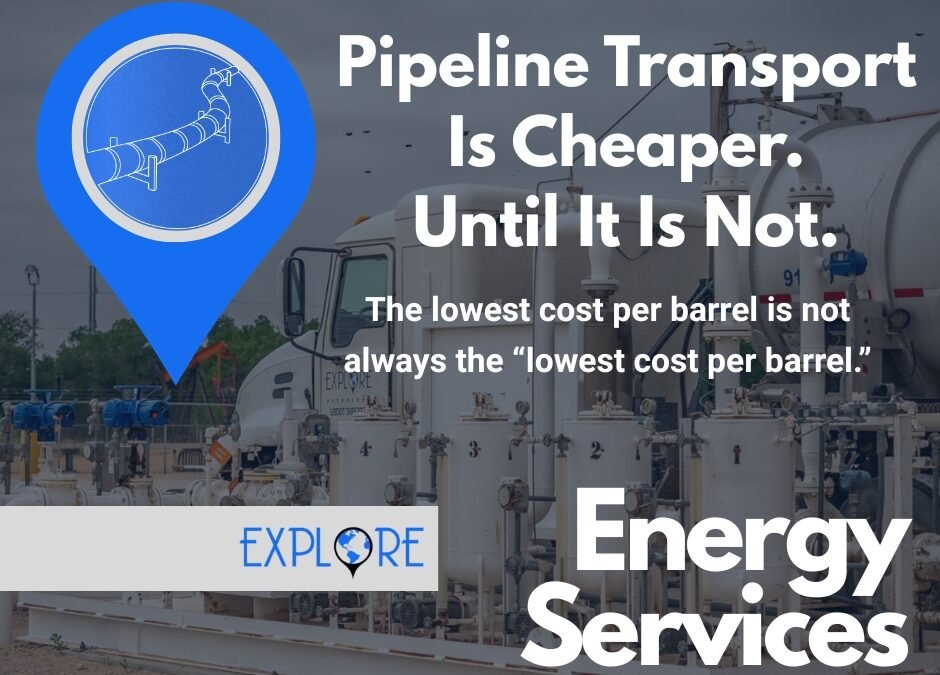
TL;DR: Pipeline Transport vs Trucking for Crude: When Each One Actually Wins
Pipeline transport is cheaper per barrel under stable capacity conditions. Trucking is more flexible, faster to deploy, and often necessary when pipeline takeaway tightens. The right answer for any specific transport lane depends on three variables: cost per barrel, flexibility under capacity constraint, and timing alignment with field operations.
Steven here with Business Dev at Explore Logistics. I have spent the last several years sitting across the table from operators, midstream teams, and crude marketers who are trying to answer the same question: pipeline transport or trucking for crude. Most of the time, the answer is not one or the other. It is the right blend, at the right moment, for the transportation lane in front of you. This article walks through the decision the way our team at Explore Logistics walks through it with clients, including the moments when the cost math flips and trucking quietly becomes the cheaper option.
What is the actual cost difference between pipeline transport and trucking for crude?
Under stable conditions, pipeline transport moves crude at a small fraction of the per-barrel cost of trucking. The gap is significant enough that most operators default to pipeline as the baseline movement option. What does not show up in the rate sheet is the cost of inflexibility. A pipeline ties a producer to one direction, one tariff structure, and one set of contracted shippers. When market basis shifts or downstream demand changes, the cost advantage can shrink.
Trucking carries a higher per-barrel rate. It also carries decision flexibility. A trucked barrel can change destination, change refiner, or change basin in days. A pipeline barrel cannot.
When does pipeline transport stop being the cheaper option?
Three scenarios consistently flip the math in our experience working with operators in the Permian Basin and the Eagle Ford:
- Takeaway tightens. When a major pipeline runs at full utilization, marginal barrels face curtailment or steep basis discounts. The all-in cost of staying on pipe can exceed the rate of trucking those barrels to a different outlet.
- Basis differential widens. When the spread between basin-level and Gulf Coast prices moves sharply, trucking to a better outlet can outperform sitting on a contracted pipe shipment.
- Field schedules shift. When a producer needs faster cycle time between production and sale, pipeline contract terms can become a constraint instead of a feature.
Where does the pipeline truck concept fit in?
The phrase “pipeline truck” describes the hybrid transportation lane. It is the trucking activity that bridges the gap when takeaway tightens, when a producer wants to test a new outlet, or when seasonal demand creates a short-term need that does not justify a new pipeline interconnect.
Operators who treat pipeline trucks as a default tool in the kit, rather than an emergency response, tend to maintain steadier realized prices through capacity cycles.
How should procurement teams structure their crude movement contracts?
In every operator conversation our team has at Explore Group, three structural recommendations come up:
- Segment crude movement by certainty. Lock long-term pipe capacity for the base load. Reserve trucking and rail for the marginal barrels where flexibility has option value.
- Build pricing flexibility into trucking transportation lanes. When takeaway tightens, surge pricing on trucking can erode the savings if the contract is not structured for it.
- Keep one accountable operations contact across the blended capacity. Splitting the pipeline and trucking across two different vendor relationships almost always creates handoff failures when capacity shifts.
How does Explore Group approach pipeline transport vs trucking decisions?
We coordinate crude movement as a blended capacity decision. Our team integrates pipeline shipper relationships, trucking fleet posture across the Permian and Eagle Ford, and rail terminal access into one operational picture.
When takeaway tightens, we have the trucking and rail capacity already structured to absorb the gap.
When pipeline capacity is open, we make sure the baseline barrels are riding the lowest-cost transportation lane available.
Frequently Asked Questions
- Is pipeline transport always cheaper than trucking for crude? Per barrel, usually yes, under stable capacity conditions. The cost advantage erodes when takeaway tightens or when flexibility creates option value.
- What is takeaway capacity? The total volume a region’s pipeline infrastructure can carry from production to refining or storage. When utilization runs near 100 percent, marginal producers face curtailment or basis discounts.
- Can trucking replace pipeline transport entirely? Not at scale. Trucking is a flexibility tool. For base-load volumes, pipeline remains the lowest-cost option in most basins.
- How quickly can trucking respond to a capacity event? With pre-structured trucking capacity, response can be measured in days. Without pre-structured capacity, response often takes weeks at premium rates.
- Does Explore Group own pipeline assets? Explore Group does not own long-haul pipelines. We coordinate movement across pipe, truck, and rail as an integrated capacity partner.
Final Takeaway:
If your team is treating pipeline transport vs trucking for crude as a one-or-the-other decision, the cost is showing up somewhere else.
Contact us here directly to scope a blended crude movement plan.
Click Here To Learn More About Our BusinessAuthor bio

Steven Wright leads Business Development at Explore Group, a Houston-based energy and logistics company that operates across frac sand development, oilfield transportation, crude transport, equipment leasing, and resource development. He works directly with operators, procurement teams, capital partners, and mineral owners on the supply-chain and capital decisions behind active energy programs in the Permian Basin, Eagle Ford, and the Gulf Coast.
Connect on LinkedIn at https://www.linkedin.com/in/wright3122/.